Behavioural Anomaly Detection: How AI Stops Account Takeover Before the Password Is Stolen
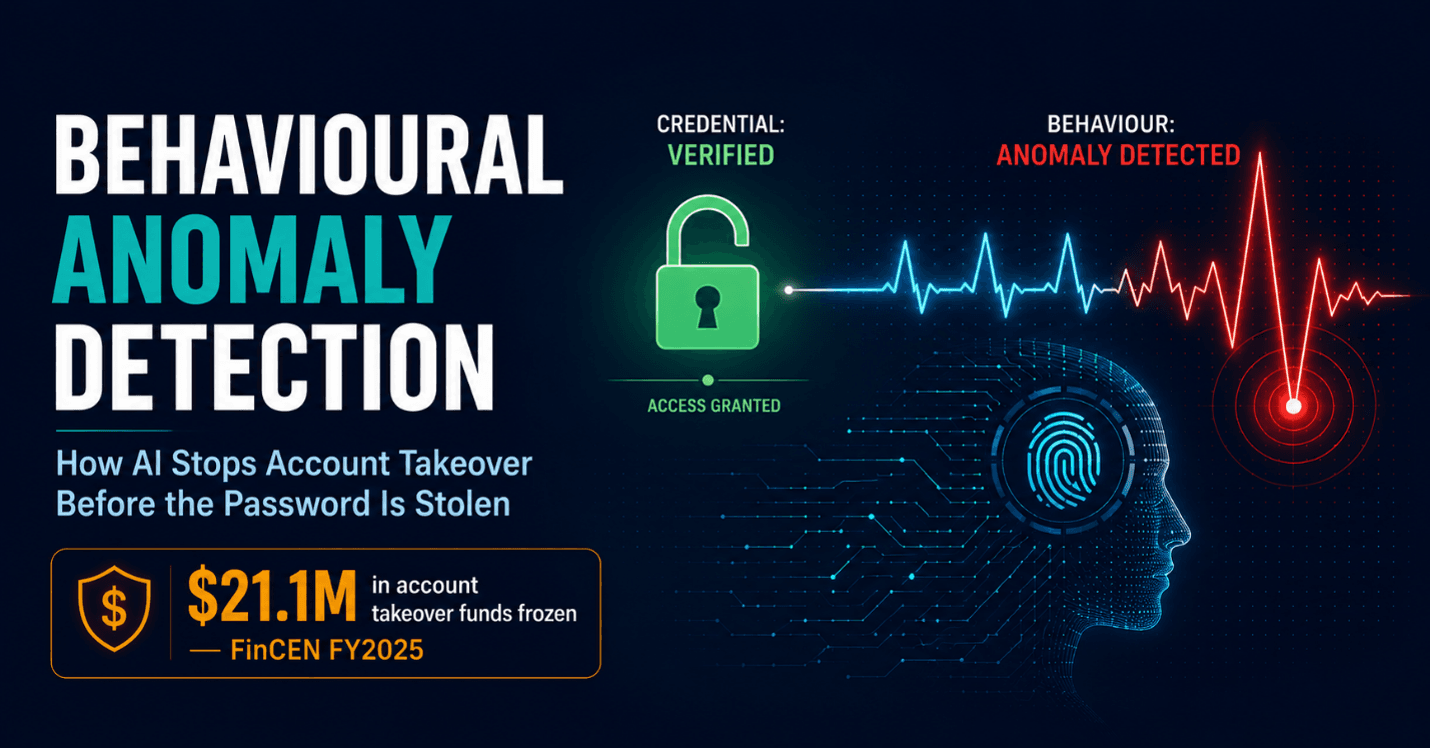
Account takeover does not start with a stolen password. It starts with a login that looks correct on paper and wrong in context, the right credentials, used from an unfamiliar device, at an unusual hour, behaving nothing like the genuine account holder. Behavioural anomaly detection is built to catch exactly that moment. Rather than verifying who has the password, it continuously evaluates how someone is actually using the account typing rhythm, navigation pattern, session timing, device signals, and flags the deviation before a single fraudulent transaction completes. FinCEN’s November 2024 alert on AI-enabled fraud (FIN-2024-Alert004) identifies geographic and device data inconsistency as a primary red flag indicator a signal that sits at the session level, not the transaction level.
Why Account Takeover Defeats Password-Based Defences
Passwords authenticate a credential, not a person. Once a credential is compromised through phishing, credential stuffing, or a data breach a password-based system has no further defence. The attacker logs in correctly. Every static check passes.
This is the gap account takeover is engineered to exploit. FinCEN’s 2024 alert on GenAI fraud schemes (FIN-2024-Alert004) reports a sustained increase in suspicious activity filings in which fraudsters used stolen or synthetically generated credentials to gain access that appeared entirely legitimate to static authentication controls. The alert is explicit: institutions cannot rely on credential-level verification alone ongoing behavioural monitoring is required to identify session-level inconsistencies that the login event itself will never reveal.
WHAT FINCEN’S 2024 ALERT SAYS TO WATCH FOR
FIN-2024-Alert004 identifies specific behavioural red flags that indicate fraud even when credentials appear correct: geographic or device data inconsistent with the customer’s identity, rapid transactions on accounts with little prior history, high payment volumes to high-risk payees, and account behaviour that does not match the established customer profile. These are session-level and behavioural signals, not credential failures. They are only detectable through continuous monitoring, not point-in-time authentication.
What Behavioural Anomaly Detection Actually Measures
Behavioural anomaly detection builds a continuous profile of how a genuine account holder behaves not just what credentials they hold. Typing cadence, mouse movement patterns, navigation sequences through an application, typical session length, and device and location consistency all form a behavioural baseline unique to that user.
Consider a representative scenario: A genuine account holder logs in at 9am from London on their usual laptop, navigates to payments, and initiates a routine transfer. The same account logs in at 3am from a different country on an unrecognised device, navigates directly to the wire transfer screen without visiting any other section, and immediately requests the maximum available limit. The credentials are identical. The behaviour is categorically different. Behavioural anomaly detection flags the second session before the transfer completes.
This is the architecture described in NIST Special Publication 800-63B, the US government’s official digital identity guidelines, which recommends risk-based authentication using claimant behaviours, IP address, geolocation, timing patterns, and browser metadata, to identify activity falling outside typical norms. NIST’s guidance explicitly frames this as a continuous requirement, not a one-time login check.
$21.1 million funds specifically tied to account takeover frozen through FinCEN’s Rapid Response Program in a single fiscal year (FinCEN Year in Review FY2025).
Where the Official Standards Already Point
NIST SP 800-63B is explicit about why this matters at the architecture level: account takeover is defined in the standard as one of the core risks an authentication system must be designed against, an attacker who compromises or steals an authenticator and accesses an account that was not rightfully theirs.
The standard’s recommendation is continuous, not one-time, verification. A password check happens once, at login. Behavioural monitoring happens for the duration of the session meaning an account takeover that successfully passes the initial login can still be detected and stopped before any damage occurs, simply because the behaviour afterwards does not match the account holder’s pattern.
FinCEN’s 2024 alert reinforces this directly. It recommends that institutions monitor accounts for suspicious activity beyond the onboarding and authentication stage specifically flagging behavioural patterns such as rapid transactions, unusual payee profiles, and device inconsistency that only become visible through continuous session-level monitoring. The regulatory direction from both NIST and FinCEN points to the same architecture: behavioural monitoring that runs for the life of the session, not just the moment of login.
WHY THIS MATTERS FOR PRODUCT AND FRAUD TEAMS
Behavioural detection does not require adding friction to login no extra OTP, no additional password prompt. It operates silently in the background, evaluating session behaviour rather than interrupting the user. This is the structural advantage over step-up authentication: protection without degrading the customer experience that static security checks unavoidably add.
Key Takeaways
- Account takeover succeeds because passwords authenticate a credential, not a person once stolen, every static check passes.
- FinCEN’s November 2024 alert (FIN-2024-Alert004) identifies geographic and device inconsistency, rapid transactions, and abnormal account behaviour as the primary session-level signals institutions must monitor.
- NIST SP 800-63B explicitly recommends risk-based behavioural signals IP, geolocation, timing, device metadata to identify activity outside typical account norms.
- Behavioural anomaly detection protects continuously through a session, catching takeover that has already passed the login without adding customer friction.
- The test is not whether the password is correct. It is whether the behaviour matches. Those are fundamentally different questions and only one of them catches the attacker.
If your fraud monitoring starts at the transaction rather than the session, account takeover is already inside your perimeter before detection begins.
Vericent’s behavioural anomaly detection identifies account takeover in real time without adding friction to your login experience. Built on the continuous monitoring principles set out in NIST SP 800-63B and aligned with FinCEN’s 2024 red flag guidance. Request a technical walkthrough for your fraud and product teams.
Frequently Asked Questions
1. How is behavioural anomaly detection different from password protection?
Passwords verify a credential once, at login. Behavioural anomaly detection evaluates how the account is used throughout the entire session catching an attacker who has already passed the password check.
2. Can account takeover be detected without the customer noticing extra security steps?
Yes behavioural monitoring operates passively using signals like device fingerprint, session timing, and navigation pattern. NIST SP 800-63B recommends exactly this kind of risk-based monitoring as protection without added login friction.
3. What behavioural signals indicate a likely account takeover?
FinCEN’s November 2024 alert (FIN-2024-Alert004) flags geographic or device data inconsistent with the customer profile, rapid transactions on accounts with little prior history, and behaviour that does not match the established account pattern. All are detectable through continuous session monitoring, regardless of whether login credentials were correct.