From Rules to Reasoning: How Machine Learning Eliminates the False Positive Crisis in Enterprise Fraud
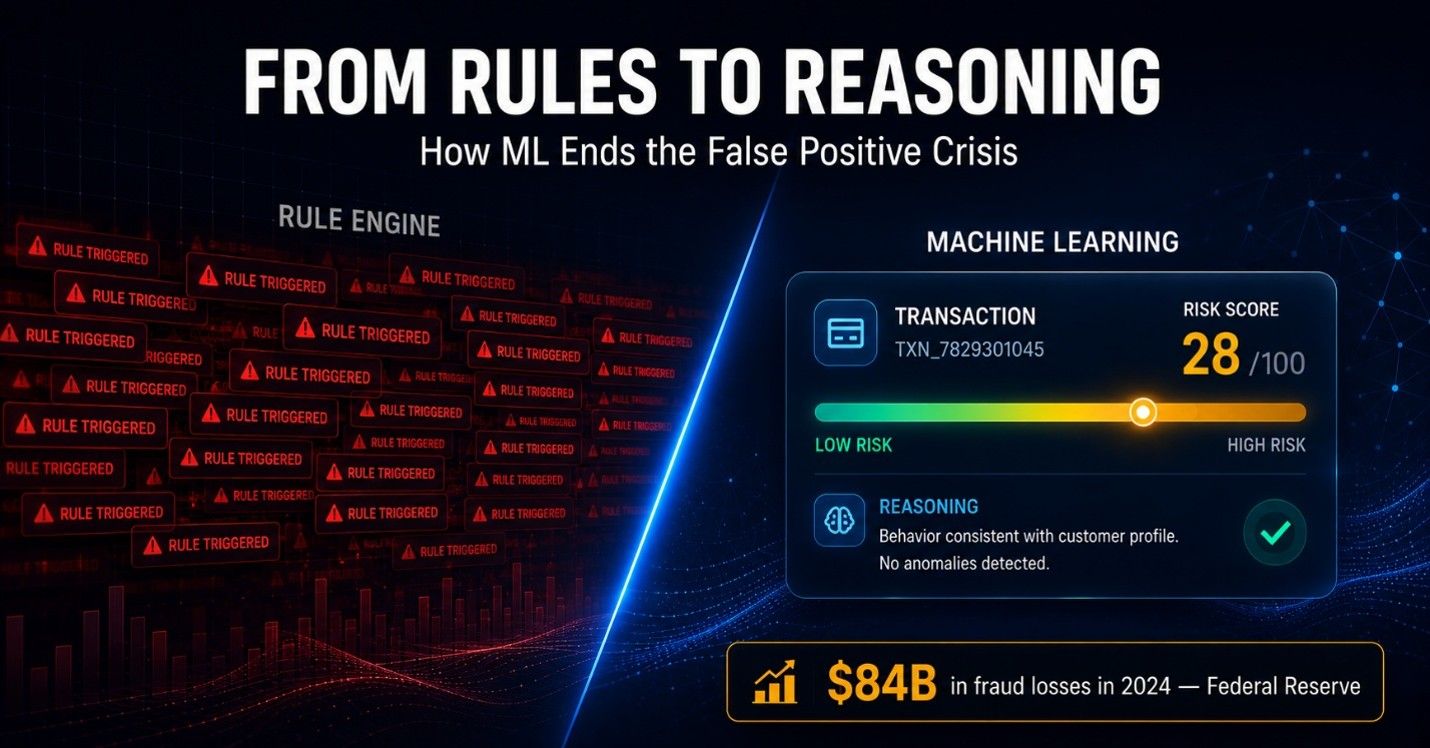
The false positive is the hidden cost that most enterprise fraud reporting does not capture. A transaction declined in error is not a fraud loss, so it does not appear on the fraud P&L. But it is a customer lost, an investigation opened, an analyst hour consumed, and in aggregate, a material operational cost that scales directly with the volume of transactions a rule-based system processes. As Federal Reserve Vice Chair Bowman confirmed in May 2026, non-credit card fraud losses across the US financial system reached $84 billion in 2024 with only $21 billion recovered. The detection architecture responsible for those outcomes is, at most institutions, still built on rules.
IN BRIEF: RULES vs MACHINE LEARNING
Rule-based systems: evaluate each transaction against fixed thresholds. When a threshold is crossed, a flag is raised regardless of whether the behaviour is actually fraudulent in context.
Machine learning models: learn from the full behavioural history of an account and evaluate each transaction against what is normal for that specific customer, device, channel, and time producing a risk score rather than a binary flag.
Why Rule-Based Fraud Detection Creates the False Positive Problem
Rule-based fraud detection was engineered for a world where transaction volumes were manageable and fraud typologies were stable. A rule flagging transactions above £500 outside the account holder’s home country made sense when international transactions were rare. It is operationally destructive when applied to a customer base of frequent international travellers, digital nomads, and cross-border workers.
Rules do not learn. Once written, a rule applies identically to every transaction that matches its parameters regardless of context, account history, or behavioural baseline. The result is a false positive rate that rises as customer behaviour diversifies and fraud typologies evolve around the rule thresholds. A sophisticated fraud operation will quickly learn where the rules sit and calibrate its activity to remain just below them. A legitimate customer travelling abroad will trigger them without hesitation.
THE OPERATIONAL COST RULES NEVER SHOW
Every false positive triggers a review workflow: alert triage, analyst investigation, customer contact attempt, resolution, and case closure. At scale, that workflow consumes fraud operations capacity that should be directed at genuine threats. The ACFE’s 2024 Report to the Nations estimates organisations lose approximately 5% of annual revenues to fraud annually a figure that includes both undetected fraud losses and the operational overhead of managing an over-flagging detection system. Neither cost is visible on a false positive rate dashboard.
What Machine Learning Actually Changes About Fraud Detection Logic
The fundamental difference between rule-based detection and machine learning is not speed it is the unit of analysis. A rule compares a transaction to a threshold. A machine learning model compares a transaction to the full behavioural history of that account, that device, that customer segment, and that transaction type, simultaneously.
Consider what this means in practice: A £2,400 transfer from a UK account at 11pm is flagged by a rule-based system because it exceeds a £2,000 overnight threshold. For a customer who regularly transfers similar amounts to a family member every month at the same time, the ML model assigns a low risk score. For a new account, on a first-use device, initiating the same transfer at the same hour, the model assigns a high risk score. Same transaction amount. Same time. Categorically different risk profile. The rule cannot see the difference. The model can.
This contextual scoring is what eliminates the structural false positive problem. Alerts are generated not when a threshold is crossed, but when the risk score exceeds a calibrated threshold based on the specific account’s behavioural baseline. The investigation queue shrinks. Analyst capacity concentrates on genuinely high-risk events. Customer experience improves because legitimate transactions are no longer disrupted by rules that cannot read context.
The Regulatory Framework That Now Governs ML Fraud Models
The model risk management framework that governs how US banks develop, validate, and govern quantitative models — including fraud detection ML models was updated for the first time in fifteen years in April 2026. SR 26-2, issued jointly by the Federal Reserve, OCC, and FDIC on 17 April 2026, replaces SR 11-7 as the primary model risk management standard. The updated guidance explicitly acknowledges that fraud detection models evolve with emerging threats and that pre-deployment validation alone cannot govern a system that changes after deployment. Continuous monitoring and performance validation are now formally required.
For fraud technology leaders, SR 26-2 has a direct operational implication: any ML fraud model must now be governed with documented performance monitoring, drift detection, and ongoing validation processes. A model trained on 2024 fraud patterns and never retrained is not simply underperforming it is a model risk management exposure. The regulatory expectation is explicit: the model must be validated against current fraud behaviour, not historical baselines.
THE GOVERNANCE QUESTION SR 26-2 CREATES
SR 26-2 does not reduce the obligation to govern ML fraud models it raises it. The question for CROs and fraud technology heads is not whether ML models are in scope. They are. The question is whether the model development, validation, and continuous monitoring processes meet a standard that has materially changed since the last examination cycle. Institutions that governed models under SR 11-7 should assume their MRM programme needs review against SR 26-2 requirements before their next supervisory engagement.
Key Takeaways
- Rule-based fraud detection flags transactions against fixed thresholds with no contextual awareness generating false positives at a rate that scales with customer diversity and fraud sophistication.
- Machine learning models evaluate each transaction against the account’s full behavioural baseline, producing a risk score that captures context a rule cannot see reducing false positives without reducing genuine fraud detection.
- Federal Reserve Vice Chair Bowman (May 2026) confirmed $84 billion in non-credit card fraud losses in 2024, with only $21 billion recovered a detection architecture failure at institutional scale.
- SR 26-2 (April 2026) replaces SR 11-7 as the US model risk management standard and explicitly requires continuous monitoring, drift detection, and ongoing validation for ML fraud models not just pre-deployment testing.
- An ML fraud model trained on historical data and never retrained is not only underperforming it is now a documented model risk management exposure under the updated regulatory framework.
If your fraud detection architecture is still primarily rule-based, the false positive cost is invisible on your fraud dashboard but it is very visible to your customers and your operations team.
Vericent’s ML fraud detection platform replaces static rule thresholds with continuously trained behavioural models reducing false positives, concentrating analyst capacity on genuine threats, and meeting the continuous monitoring requirements of SR 26-2. Request a model architecture walkthrough.
Frequently Asked Questions
1. What causes high false positive rates in fraud detection?
Rule-based systems flag every transaction that crosses a fixed threshold, regardless of whether the behaviour is normal for that specific account. Because rules cannot read context, legitimate transactions from customers with atypical but genuine behaviour are consistently over-flagged.
2. How does machine learning reduce false positives without missing real fraud?
ML models score each transaction against the account’s own behavioural baseline rather than a fixed threshold applied equally to everyone. A transaction that looks unusual in isolation looks normal against the account history and vice versa for genuine fraud.
3. What does SR 26-2 require for ML fraud detection models?
SR 26-2 (April 2026) requires continuous monitoring, drift detection, and ongoing validation for any ML model used in fraud detection not just pre-deployment testing. Institutions whose model governance was built around the prior SR 11-7 standard should review their MRM programmes against the updated requirements.