Cutting Tier-1 Alert Fatigue: How Multi-LLM AI Slashes Investigation Times by Up to 75%
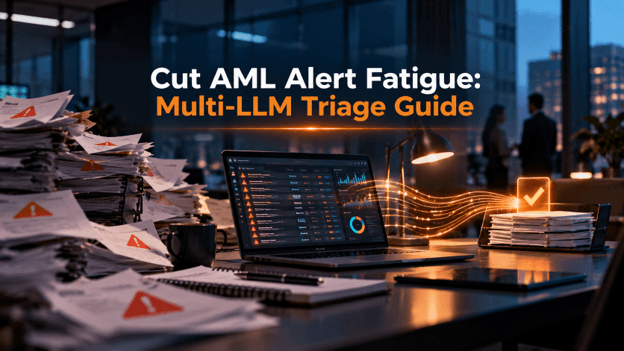
In the financial crime operations centres of major Australian banks and financial institutions, the biggest threat to compliance is not sophisticated criminals, it is the sheer volume of non-actionable noise. Across the banking sector, legacy transaction monitoring rules generate industry-wide false-positive rates consistently sitting between 85% and 95%. This means that up to 19 out of every 20 alerts flagged for manual investigator review represent entirely legitimate commercial and retail customer activity.
Under AUSTRAC's formal Statement of Regulatory Expectations, reporting entities must maintain effective transaction monitoring programs calibrated to actual criminal harm. Yet when Tier-1 fraud analysts spend 30 to 45 minutes swivel-chairing across core banking databases, CRM profiles, and payment rails to close an obvious false alert, investigative capacity collapses. Chronic alert fatigue leads directly to missed suspicious matters, human error, and acute operational burnout. This article breaks down the mathematical economics of the false-positive crisis, explores why legacy rules engines cannot solve the problem, and details how multi-LLM artificial intelligence slashes investigation triage cycles by up to 75% without compromising regulatory audit defensibility.
The Mathematics of Alert Fatigue: The 95% Noise Trap
For fraud operations managers and AML compliance leads, false positives are not merely an administrative nuisance; they represent a crippling operational tax on institutional risk management. Consider the operational baseline of a mid-tier Australian ADI or high-growth fintech:
- Daily Ingestion Volume: 1,000 transaction monitoring alerts generated per business day by deterministic rule engines.
- The False-Positive Reality (90%): 900 non-actionable alerts requiring manual human triage, documentation, and formal disposition.
- Analyst Labour Allocation: At an average triage time of 35 minutes per alert, 900 false alerts consume 525 analyst hours every single day.
- Operational Overhead: Equivalent to a dedicated team of over 65 full-time Tier-1 investigators doing nothing but closing benign transactions.
Operational Reality
The Operational Bottleneck: When Tier-1 analysts review hundreds of benign transactions a week, cognitive fatigue sets in. The greatest regulatory hazard is not the false positive itself, but the genuine money laundering scheme or high-velocity mule transfer dismissed because an exhausted investigator rushed through triage.
Why Legacy Rules Cannot Solve the Alert Crisis
For years, compliance leaders attempted to tune their way out of alert fatigue by adjusting static rules. However, deterministic systems suffer from fundamental structural limitations that guarantee high false-positive rates:
- The 'Isolated Transaction' Blind Spot: A deterministic rule triggers when a payment breaches a single parameter (e.g., 'wire > $10,000 to an offshore beneficiary'). The rule cannot determine whether the customer is a corporate importer whose monthly commercial invoices consistently average $12,000, or a newly opened retail account exhibiting abnormal velocity.
- Swivel-Chair Investigation Latency: Tier-1 investigators do not spend 30 minutes reading the transaction; they spend 30 minutes logging into fragmented systems retrieving identity documents from KYC databases, checking core banking ledgers, searching internal PEP lists, and verifying device telemetry.
- Threshold Fear and Regulatory De-Risking: Fearing regulatory censure from AUSTRAC for unflagged illicit activity, risk officers set rule thresholds excessively broad. This defensive posture catches edge-case anomalies, but floods the operations floor with unmanageable noise.
The Architectural Shift: How Multi-LLM AI Re-engineers Triage
Cutting triage time by 75% cannot be achieved through marginal process improvements; it requires automating the cognitive contextualization that human investigators perform manually. Rather than relying on a single monolithic algorithm, modern alert triage utilizes a Multi-LLM agentic architecture where specialized AI models collaborate across distinct investigative tasks:
- Agent 1: Enterprise Data Synthesis: Upon an alert trigger, the ingestion model instantly interfaces across 50+ enterprise systems (core banking ledgers, KYC profiles, device telemetry, and sanctions watchlists), pulling fragmented records into a unified contextual snapshot in milliseconds.
- Agent 2: Behavioural Baseline Evaluation: A dedicated analytical model evaluates the transaction against the customer's established multi-dimensional profile, historical peer group benchmarks, and expected commercial volumes determining whether the wire represents genuine operational divergence.
- Agent 3: Narrative Assembly & Evidence Compilation: The reasoning model generates a complete, plain-language investigative summary detailing the exact risk factors, historical corroboration, and an explainable risk score pre-drafting an audit-ready disposition note.
- Human-in-the-Loop Decision Execution: The human investigator reviews an executive dossier rather than a raw, uncontextualized alert. With all evidence pre-compiled, the decision to clear the alert or escalate to an SMR takes 5 minutes instead of 40.
Workflow Comparison: Manual Triage vs. Multi-LLM Automation
The table below demonstrates how automated contextualization transforms the Tier-1 investigative workflow:
1. Data Extraction
- Legacy: Manual logins across 4-6 systems (~15 minutes)
- FraudCentral: Automated cross-system integration in seconds
2. Baseline Contextualization
- Legacy: Manual review of transaction history and invoices (~12 minutes)
- FraudCentral: Automated behavioral anomaly scoring against peer baselines
3. Documentation & Logging
- Legacy: Manual case notes and screenshot collection (~10 minutes)
- FraudCentral: Pre-built audit-ready dossier with visual analytics
4. Triage Escalation / Closure
- Legacy: Manual assignment or email escalation to Tier-2/MLRO (~5 minutes)
- FraudCentral: One-click approval with automated AUSTRAC SMR formatting
5. Overall Impact
- Legacy workflow: 35-45 minutes per alert
- FraudCentral Multi-LLM workflow: 5-8 minutes per alert
- Up to 75% reduction in investigation time
Preserving 100% Audit Compliance: Overcoming the 'Black Box' Hurdle
A critical challenge for compliance executives evaluating artificial intelligence is supervisory explainability. Under Section 36 of the AML/CTF Act and AUSTRAC's governance expectations, reporting entities cannot delegate compliance decisions to an opaque 'black-box' algorithm. If an institution cannot explain to an auditor why an alert was auto-closed or escalated, the technology becomes a legal liability.
Modern Multi-LLM platforms resolve this challenge through deterministic explainability rails:
- Chain-of-Thought Audit Trails: Every analytical evaluation generates an immutable, timestamped record documenting the exact evidence accessed, the rules triggered, and the specific behavioural thresholds evaluated.
- Zero 'Hallucination' Safeguards: Enterprise AI triage engines utilize Retrieval-Augmented Generation (RAG) anchored exclusively to verified internal banking records and official AUSTRAC typologies—eliminating generative extrapolation.
- Human Oversight at the Boundary: AI serves as an intelligent investigative co-pilot. High-risk matters, potential SMR escalations, and accounts subject to Section 49 information requests always require affirmative sign-off by a qualified human investigator.
How FraudCentral Cuts Alert Friction Across Enterprise Rails
Vericent’s FraudCentral platform is purpose-built to eliminate alert fatigue and accelerate investigation throughput without sacrificing institutional control:
- Multi-LLM Contextualization: FraudCentral continuously evaluates transaction and behavioural signals together rather than in isolation, contextualizing payments against historical baselines and entity networks.
- Unified Investigation Dashboard: Consolidates cross-channel alerts into a single, intuitive workspace eliminating swivel-chair data retrieval across core ledgers, ERP systems, and external risk feeds.
- 75% Faster Investigations: By automating evidence gathering, risk scoring, and narrative drafting, Tier-1 analysts resolve files up to 75% faster, eradicating alert backlogs and meeting statutory SMR deadlines.
- 50+ Enterprise Integrations: Connects seamlessly into modern banking and payment stacks (NPP, PayID, RTGS, SWIFT, and ERP ledgers), orchestrating real-time intervention before illicit funds exit the institution.
Conclusion
The 95% false-positive rate is not an unavoidable cost of doing business it is an architectural flaw of legacy, rule-based systems. As regulatory enforcement from AUSTRAC accelerates and criminal typologies evolve across real-time rails, financial institutions cannot hire their way out of alert fatigue. By deploying Multi-LLM behavioural triage, fraud operations leaders can eliminate non-actionable operational friction, cut investigation cycles by up to 75%, and empower investigators to focus their cognitive capacity on what truly matters: stopping financial crime and protecting the integrity of the financial system.
Frequently Asked Questions (FAQ)
Q: What causes high false-positive rates in AML transaction monitoring?
A: High false-positive rates (typically 85%–95%) are caused by legacy deterministic rule engines that evaluate transactions against rigid thresholds in isolation, lacking behavioural baselines, customer occupation context, or cross-system intelligence.
Q: How does alert fatigue increase regulatory non-compliance risk?
A: When investigators are overwhelmed by hundreds of benign alerts, cognitive fatigue causes them to rush reviews. This increases the risk of missing genuine financial crime, delaying statutory SMR filings past AUSTRAC's 24-hour and 3-day deadlines, and breaching Section 41 obligations.
Q: What is Multi-LLM AI in the context of fraud alert triage?
A: Multi-LLM AI deploys specialized, collaborating artificial intelligence agents to automate distinct investigative tasks: retrieving data across core systems, scoring behavioural divergence, assembling contextual evidence, and pre-drafting audit-ready narrative summaries for human review.
Q: How does FraudCentral cut investigation times by up to 75%?
A: FraudCentral automates the manual 30-minute swivel-chair data gathering process, presenting investigators with a pre-compiled entity risk dossier and plain-language explanation in a unified dashboard, reducing review time from 35–45 minutes to 5–8 minutes per alert.
Q: Does automated alert triage meet AUSTRAC's audit and explainability standards?
A: Yes. By utilizing deterministic explainability rails, immutable audit logs, and keeping qualified human investigators in the decision loop, FraudCentral delivers 100% audit-compliant records that clearly substantiate every triage decision to internal auditors and AUSTRAC examiners.